Bangladesh is a delta of clay with almost no building stone, so for more than a thousand years its builders have burnt their own. The brick monastery at Paharpur, the mosques of Bagerhat and the terracotta panels of Kantajew Temple all come from that clay. Today most buildings in the country still have brick walls, even when a concrete frame carries the load. Here is a practical guide: the bricks you will be offered, how to check them, the common bonds, jali walls and the security of their openings, exposed brick, and how we use brick in our own work.
The short answer
A standard brick in Bangladesh is about 9.5 × 4.5 × 2.75 inches (240 × 115 × 70 mm). Use first-class bricks for any wall you will see or load. Over-burnt picked jhama bricks are broken into chips for concrete and soling. Most walls are 5 or 10 inches thick, laid in stretcher or English bond. A jali is a brick wall with openings: it shades, lets air through and keeps privacy. It works best as an outer layer in front of a veranda or garden, with openings small enough to keep people and animals out.
Types of bricks you will be offered
Type
What it is
Use it for
First class
fully burnt, even colour, sharp edges, rings when struck, absorbs little water
exposed brick, load-bearing walls, jali
Second class
burnt, but a little uneven in shape or colour, with small chips or cracks
walls that will be plastered
Third class
under-burnt, pale and soft, absorbs a lot of water
temporary work only
Picked jhama
over-burnt, dark, very hard, often bent out of shape
broken into chips (khoa) for concrete, soling and foundations
Holed bricks
machine-made bricks with rows of holes through them, such as 10-hole and 13-hole bricks
lighter walls, and jali when laid on edge
Hollow clay blocks
larger fired blocks with big open cells
ventilated screens and boundary walls
Concrete blocks
cement blocks, not fired
the government's replacement for burnt brick in public works
How to check a brick on site
Size: measure a few. Many kilns sell bricks smaller than the standard, and small bricks mean more bricks and more mortar in every wall.
Look: even colour, straight sharp edges, no cracks.
Sound: strike two bricks together. Good ones give a clear, metallic ring; under-burnt ones give a dull thud.
Water: soak a dry brick for a day. A good brick takes up no more than about 15% of its own weight in water.
Inside: break one. The inside should be even, without lumps of lime or stone, which can later crack the brick.
For a large building, send samples to a laboratory for a strength test.
Bonds and wall thickness
5-inch wall (half a brick thick), stretcher bond: inside partitions, usually plastered.
10-inch wall (one brick thick), English bond, with courses of headers and stretchers in turn: outer walls, boundary walls, and load-bearing walls in low buildings.
Flemish bond: headers and stretchers in turn within every course, a richer pattern for walls that stay exposed.
Rat-trap bond: bricks laid on edge with a hollow inside the wall. It uses roughly a fifth to a quarter fewer bricks and a third or more less mortar, and the hollow keeps heat out. It needs careful work, and an engineer's check if it carries load.
Honeycomb bond: gaps left between the bricks of each course. Most jali walls start here.
Jali: walls that breathe
A jali shades the harsh west and south sun, lets breeze and filtered light through, keeps out direct views and softens dust and noise. In our climate it does much of what a solid wall, a curtain and a window grille do, all at once.
To make it work:
Place it as an outer layer, with a veranda, corridor or garden behind it, so rain and dust stop before they reach the rooms.
Give it support. A jali is weaker than a solid wall, so tall or long screens need concrete bands, brick piers or steel ties. Ask your engineer.
Use first-class bricks and neat joints: both faces are on show.
Plan for cleaning, and for insects and birds. A fine mesh behind the screen helps where it opens onto rooms.
Every kind of opening, and its security
Each way of opening a brick wall gives a different balance of light, air, privacy and security:
Opening
How it is made
Light and air
Privacy
Security
Honeycomb gaps
gaps between bricks in each course
good
some
good when the gaps are narrow
Holed bricks on edge
10- or 13-hole bricks laid so the holes go through the wall
soft, even
high
very high: the holes are too small to reach through
Rotated or angled bricks
bricks or brick fins turned at an angle
good, and directed
high from the front
good when the fins are close together
Hollow clay blocks
fired blocks with large open cells
very good
some
depends on the cell size; add steel behind large cells
Terracotta or patterned jali blocks
made-to-order clay pieces
good
some
depends on the pattern; check the largest opening
Concrete breeze blocks
cast blocks with open patterns
very good
some
strong; check the largest opening
Ventilators
small openings high in a wall, often over windows
air only
high
high when kept small and high
Open brick panels
larger openings or arches with no screen
full
low
low: they need a grille or gate
Some rules for security:
Keep openings small near the ground and next to doors. No hand should reach through to a latch, a lock or a switch.
Where children play, near floors, stairs and roof edges, keep every opening too small for a 4-inch (100 mm) ball to pass. Many building codes use this test for railings.
In a large-opening screen, set flat steel bars inside the brick courses, so the screen is also the grille.
Move the grille away from the window. At Bhuiyan Bari we lifted it above the gardens and verandas, so the windows stay clear and the planted spaces stay inside the secure line.
Fix the jali to the frame with ties or bands, so that no one can push out a loose panel.
Exposed brick: what to know
Leaving brick unplastered saves the plaster and the paint, but asks for better bricks and better work:
Choose first-class bricks from one batch, for an even colour.
Keep the joints even, and finish them neatly.
Efflorescence, a white bloom of salt, appears when water carries salts out of the wall. Clean sand and water, good bricks, and copings and drips that keep rain off the wall all reduce it. It usually brushes or washes off once the wall dries.
Bricks or blocks?
Bangladesh has more than 7,000 brick kilns making about 23 billion bricks a year. They burn coal and dig topsoil from farmland. In 2019 the government decided that public works should change to concrete blocks by June 2025. The deadline was later moved to 2028–29, and in early 2026 most public projects were still using fired bricks. For private buildings brick is still the usual choice. Blocks are worth considering for plastered walls; for exposed walls and jali, well-made brick is hard to replace.
How we use brick
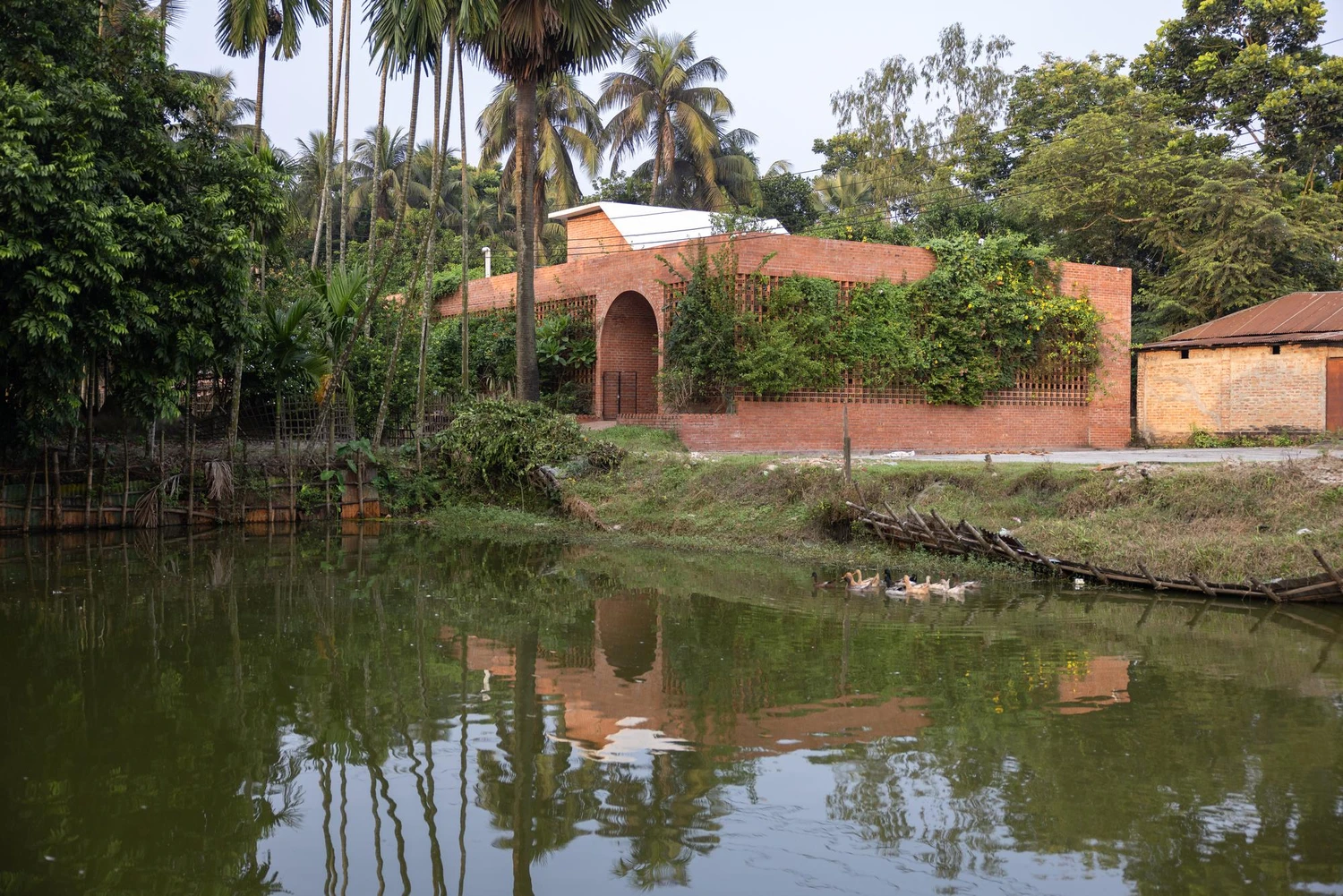
Bhuiyan Bari, Rangpur, completed: local red brick in load-bearing walls, modified running bonds, arches and vaults. On the west, a zigzag screen of 13-hole bricks filters the afternoon sun, dust and views. Specially formed U-shaped bricks hide the concrete lintels.
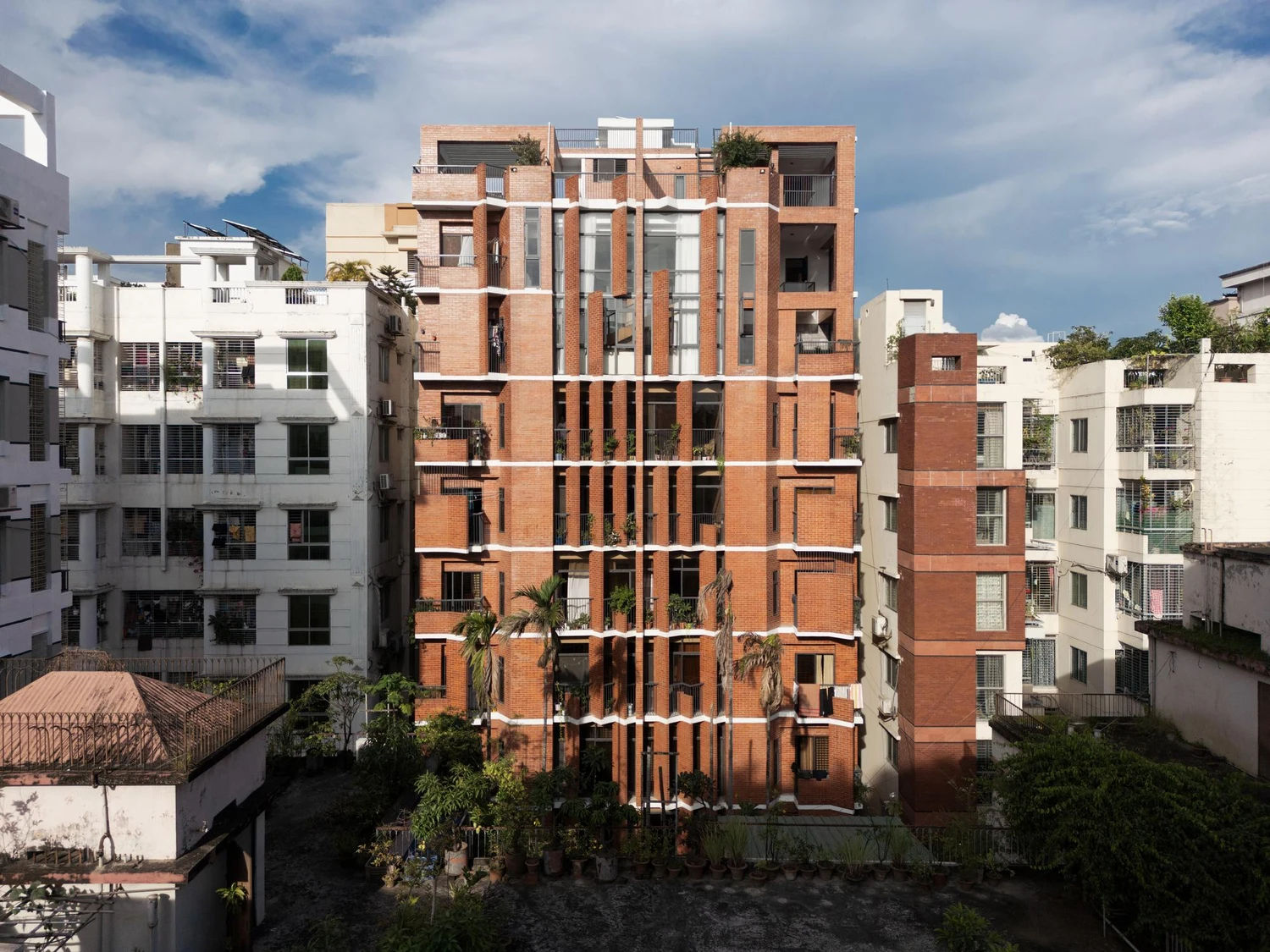
Alo Aral, Dhaka, completed: the façade was first drawn in plaster and became exposed brick. Angled brick fins shade the west sun, guide the southern breeze and keep the flats private from the building opposite.
Bari Nagolcoat, Cumilla, completed: screens of hollow clay bricks keep the parking court private but let air and light through.