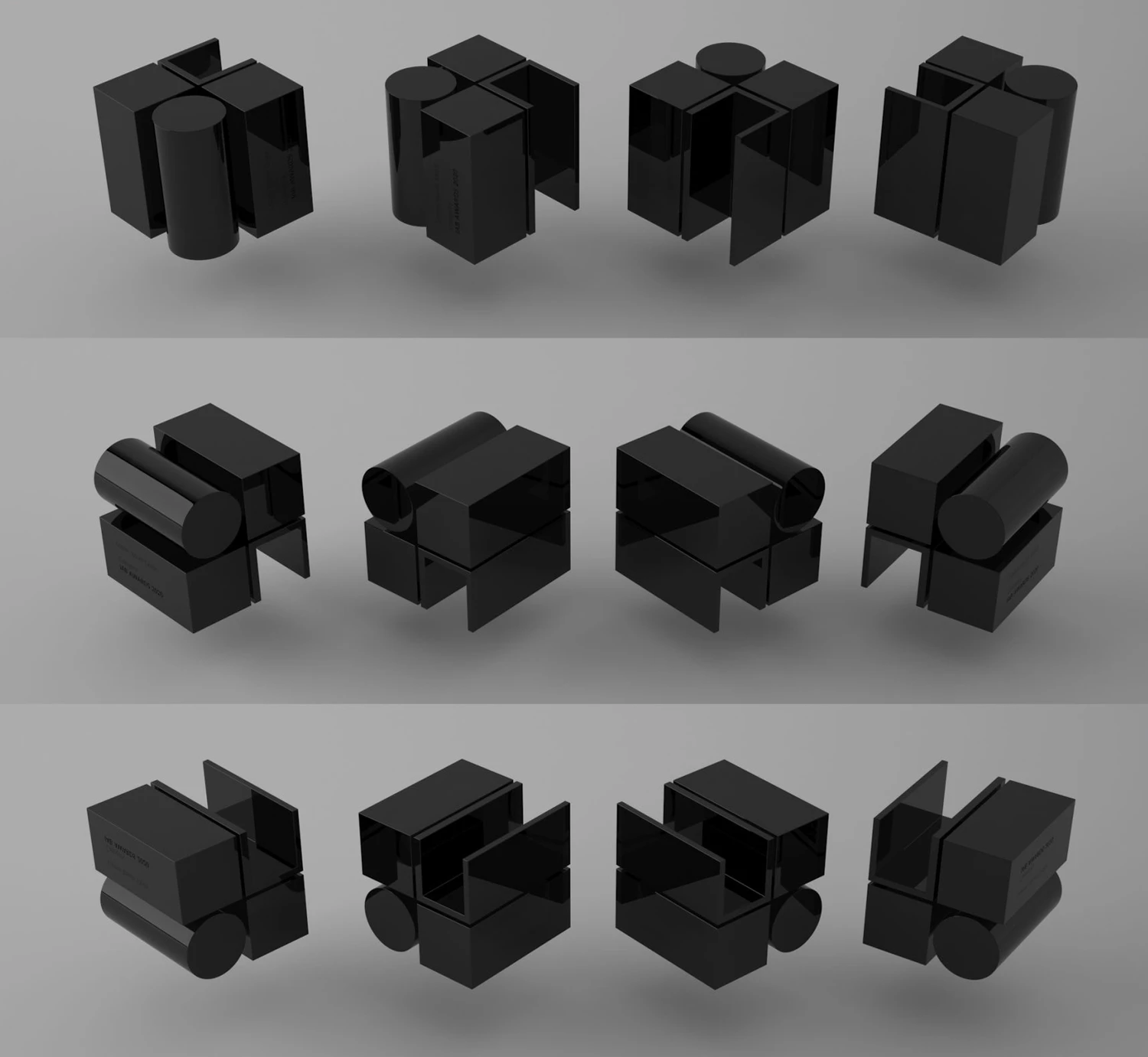
Abstract. A trophy is usually read as an emblem: it carries a name, marks a ceremony and ends up in a cabinet. This essay reads Chinta Sthapatya's 2020 entry for the IAB Awards trophy, a design that was not chosen, as a proposal about recognition itself. It follows three ideas from the studio's board: the award as sculpture, the atelier as its place, and a form that stands for a plural profession. With Bourdieu, Mauss and Cuff, it argues that the design moves recognition from ceremony into working life, and that an unchosen entry is still an argument.
1. What an award object does
In 2020 the Institute of Architects Bangladesh (IAB) held a competition for the crest, or trophy, of its awards. Chinta Sthapatya submitted a design. Another entry was chosen, and no model or prototype of this one was made. Its renderings, board and written statement take a position on a question that award objects rarely raise: what is a professional prize for?
Pierre Bourdieu described prizes, academies and critics as agents of consecration. A cultural field, in his account, does not simply discover the value of works. It produces belief in that value through institutions with the authority to declare it. A prize thus names a member of the field as worthy and confirms the institution's right to do the naming. The object handed over is the material trace of that double act.
Marcel Mauss adds a second reading: in gift exchange, a thing given is never inert. It carries something of the giver and binds the receiver to make a return. A trophy fits closely: it comes from an institution, often bears its sign, and asks something of its recipient.
2. A sculpture more than an award
The studio's board states the aim plainly: the trophy was "designed more as a sculpture than as an award". It also describes the form as an extrusion of the Institute's logo. The giver's sign is not applied to the object but built into its mass. In Mauss's terms, the Institute is present in the gift as its shape.
This reverses the usual order of a trophy, in which the inscription matters most and the object serves it. The studio says the engraving would be almost invisible, appearing only when it catches the light. In the renderings it is a few placeholder lines above the words IAB Awards 2020. The recipient's name, the heart of Bourdieu's act of naming, would be present but quiet. The object asks to be looked at before it is read.
The tension is real. A sculpture claims some independence from its occasion, while an award exists only because of one. The design does not escape the institution. It proposes that recognition can be carried by the quality of an object rather than the volume of its text.
3. A symbol for a profession of different practices
Spiro Kostof's edited history of the profession shows how variously the architect has been defined: master builder, court servant, artist, member of a professional body. An institute that admits members and honours some of them is one late arrangement among many. Dana Cuff's study of architectural offices adds that practice is collective and negotiated, unlike the lone designer that education tends to celebrate.
The studio's reading of its design answers this history. Asked how the parts relate to the Institute's logo, it explained that every architect in the IAB practises differently. The trophy's four parts, a cylinder, two square blocks and an open folded plate, are likewise different. Yet they share one colour and one material, and connect at the centre.
The design would thus give one recipient an image of the whole field, and here lies a paradox. Bourdieu's consecration singles out one person, while this symbol speaks of plurality and connection. The entry suggests that honouring one architect should also remind the profession what holds it together.
4. From ceremony to atelier
An award object is usually imagined in two places: the stage where it is handed over and the cabinet where it is kept. The studio's board names a different place. The trophy "should also sit gracefully in the atelier of the architect", on a shelf or a design table. The board's rendering sets it on a desk in a study, among books, a lamp and a cello. Having no specific base, it would be set down like a book or a tool, not mounted like a monument.
This is the design's clearest claim about meaning: recognition moves from the ceremony into the continuing life of work. The written statement calls the trophy's presence "a constant reminder of the individual's outstanding contributions to the field". On a design table, such a reminder would face forward as well as back. Read with Mauss, the return the gift asks for would be made in the next drawing. Cuff's attention to daily practice suggests why the place matters: if the profession lives in its working rooms, recognition belongs there too.
5. The unchosen entry as argument
Losing competition entries do not vanish from architectural culture. In the 1922 competition for the Chicago Tribune Tower, Eliel Saarinen's second-placed design entered architectural history alongside the winner. For Bourdieu, every work is a position-taking within a space of possibilities, whichever entry wins.
Read this way, the entry makes three claims that do not depend on winning:
an award can be a work in its own right, not only a carrier of a name;
recognition belongs where architects work, not only where they are celebrated;
a profession of different practices can be represented as one connected whole.
The entry also leaves questions open. With no model or prototype, how the pieces would be produced and joined was never tested. Its claims stand as ideas.
Conclusion
The entry treats the design of an award as the design of relations: between an institution and its members, a ceremony and a working life, one recipient and a plural profession. Its argument is that recognition can be quiet in its text, strong as an object and present at the design table. For students, it shows that designing a prize means deciding what a profession values, and that an unchosen entry can still be clear architectural thinking.
References
Bourdieu, Pierre. The Field of Cultural Production: Essays on Art and Literature. Edited by Randal Johnson. New York: Columbia University Press, 1993.
Cuff, Dana. Architecture: The Story of Practice. Cambridge, MA: MIT Press, 1991.
Kostof, Spiro, ed. The Architect: Chapters in the History of the Profession. New York: Oxford University Press, 1977.
Mauss, Marcel. The Gift: The Form and Reason for Exchange in Archaic Societies. Translated by W. D. Halls. London: Routledge, 1990.
Project:IAB award trophy, a 2020 competition entry for the IAB Awards trophy, a design that was not made. Design team Irteza Ameen Tonmoy and Mahmudul Gani Kanak.