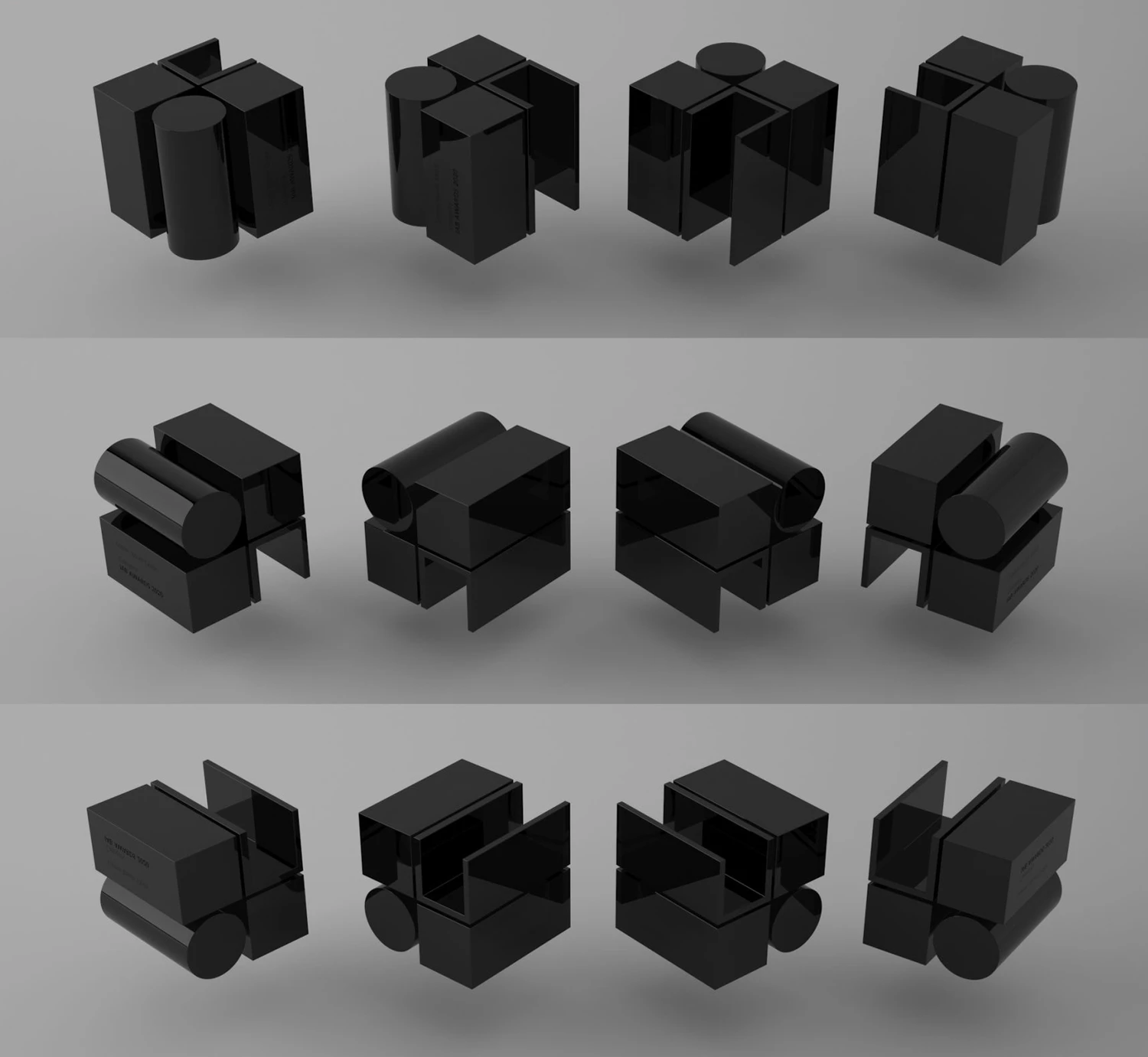
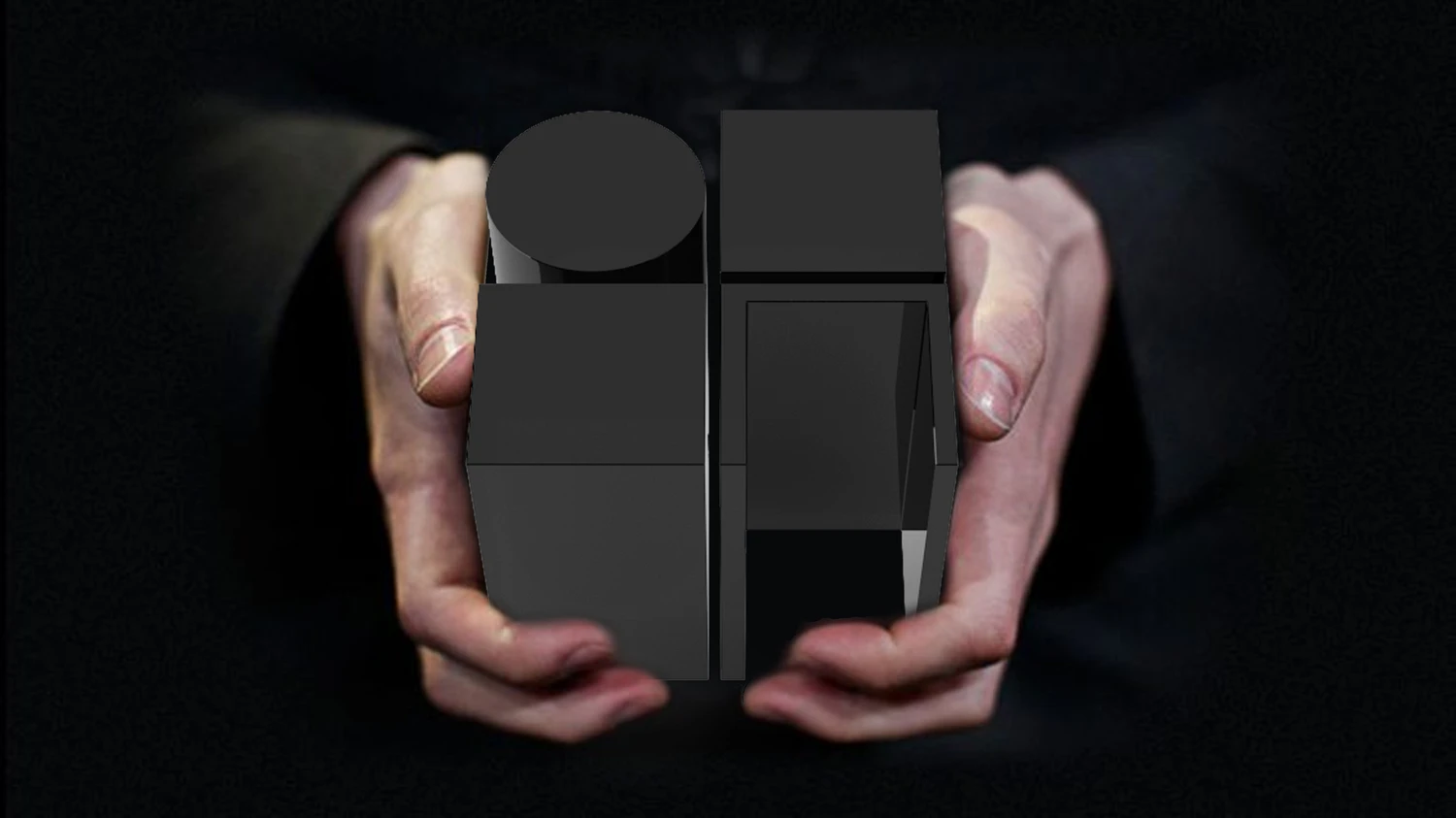
Abstract. In 2020 the Institute of Architects Bangladesh (IAB) ran a competition for the trophy of its awards. Chinta Sthapatya's entry was not chosen and was never made. The studio describes a "pure cubic form" and calls it monolithic. Its renderings, however, show four separate solids inside the cube: a cylinder, two square blocks and an open folded plate, divided by narrow slots. This essay reads the design as a problem of composition: how unlike parts can make one whole without losing their difference. Drawing on Francis Ching, Rudolf Arnheim and Robert Venturi, it finds the unity in a shared boundary, surface and centre, and the difference in the slot.
1. A cube described twice
The project page and the studio's board describe a pure cube, six inches a side, in a single black glass, and both call it monolithic. The renderings show more. Seen from above, the cube divides into four parts on a two-by-two grid, separated by a cross of narrow slots. One part is a cylinder and two are square blocks. The fourth is a folded plate, like a box with one side left open. All four are the same glossy black.
The studio's answers link the two: the shapes differ, but one colour and one material unite them, and at the centre they are all connected. With no model or prototype, the renderings and the studio's words are the only evidence. The question is one of form: what makes four separate solids, of three kinds, read as one?
2. Carved or gathered
Francis Ching distinguishes two ways in which form departs from a primary solid such as the cube. Subtractive form removes portions from a regular volume, which stays recognisable while enough of it remains. Additive form gathers separate parts, related by proximity, by contact or by a shared order such as a grid.
The design can be read both ways. Subtractively, it is a cube divided by two slots crossing at its centre, and the cube survives because the slots are narrow. Additively, it is four solids gathered on a grid; the studio confirms they are separate pieces with open spaces between them. Neither reading cancels the other: the slots are wide enough to separate the parts, narrow enough to keep the cube.
Subtraction recurs inside the parts. The folded plate wraps a hollow instead of filling its quarter. A cylinder cannot fill a square cell, so in its quarter the cube's outer edge is absent. In two quarters, then, the cube exists less as matter than as an outline on which the parts agree.
3. Seeing one thing
Why does an incomplete cube still read as a cube? Rudolf Arnheim argued that the eye organises what it sees into the simplest structure the pattern allows, and groups parts alike in colour or shape. Here the two tendencies pull apart. Shape separates the parts: curve against flat face, solid block against open shell. Colour and surface join them.
The simplest structure on offer is the cube, and the design invites the eye to supply it. Where the outer faces are flat, they lie in the planes of one cube, and perception completes the missing edge beside the cylinder. At six inches the slots read less as gaps than as lines drawn on the cube, leading inward. The studio says the parts are all connected at the centre; whatever joins them there, the slots mark the place.
4. The difficult whole
Robert Venturi argued against the easy unity that architecture reaches by leaving things out. He asked for an architecture of inclusion, one that admits contradictory elements and still achieves a whole: the difficult whole.
A cube of four identical blocks would be an easy whole. The entry instead admits a curved part, a hollow part and two plain ones, and asks one outline to hold them. The blocks fill their quarters, the cylinder falls short of its corner, and the plate encloses empty space. The pair of square blocks sets a norm against which the other two read as departures.
The studio draws a parallel: in the IAB every architect's practice is different, as the shapes are, yet all are united as one. The form carries that parallel structurally, not pictorially. It does not assign parts to practices; it shows a relation, difference kept visible inside a boundary all the parts accept. In Venturi's sense, this unity is earned by inclusion, not granted by sameness.
5. A sign without a front
The board calls the form "a simple extrusion" of the Institute's logo. To extrude is to draw a flat figure along an axis, giving it depth. A logo is a sign read from the front; extruded, it becomes a body that can be approached from any side. The sources do not describe the logo, so extrusion is read here as a method, not an image.
The board adds a second decision: the form has "no particular base to give it a dynamic viewing angle". A base usually fixes an object's top and front. Without one, any of the cube's six equal faces can serve as its bottom. Ching describes the cube as a static form with no preferred direction. The twelve renderings show one design turned to twelve angles, as the studio confirms. Each view is a test the composition must pass. As the cube turns, a cylinder reads as a rectangle or a circle, and the slots as a single line or a cross. The frontal sign becomes an object without a front.
Conclusion
The design proposes a cube that is monolithic in perception rather than in matter. Its unity comes from a shared boundary, a single black surface and a centre where, the studio says, all the parts connect. The slot keeps their difference legible. For students of composition this is the lesson: a gap lets a whole admit unlike parts. Too wide, and the cube falls into four objects; too narrow, and the parts dissolve into one block. Because the entry was never made, the balance remains a proposal on paper. Only a model could show whether the slots of a six-inch cube read as the renderings suggest.
References
Arnheim, Rudolf. Art and Visual Perception: A Psychology of the Creative Eye. Berkeley: University of California Press, 1954.
Ching, Francis D. K. Architecture: Form, Space and Order. New York: Van Nostrand Reinhold, 1979.
Venturi, Robert. Complexity and Contradiction in Architecture. New York: Museum of Modern Art, 1966.
Project:IAB award trophy, a 2020 competition entry for the IAB Awards trophy, a design that was not made. Design team Irteza Ameen Tonmoy and Mahmudul Gani Kanak.